Design Leadership - DeXL
Customer-centric product design strategy in leadership development
Overview
When I joined the team at a young edtech startup, they had a product that was part way in development but lacked a unifying strategy and a definitive audience. To help the team crystallize the product concept and determine where to begin with potential users, I had a lot of work to do.
What began as a six-week online training course pivoted to a much more sustainable and sellable product: an online evaluation tool that would give business leaders visibility into their frontline managers’ soft skills distribution.
Learners would go through a series of short, asynchronous video roleplay exercises and have them evaluated by an expert. At the end of the run, both learners and their business leaders would get reports to help guide them forward on the most effective and efficient training path.
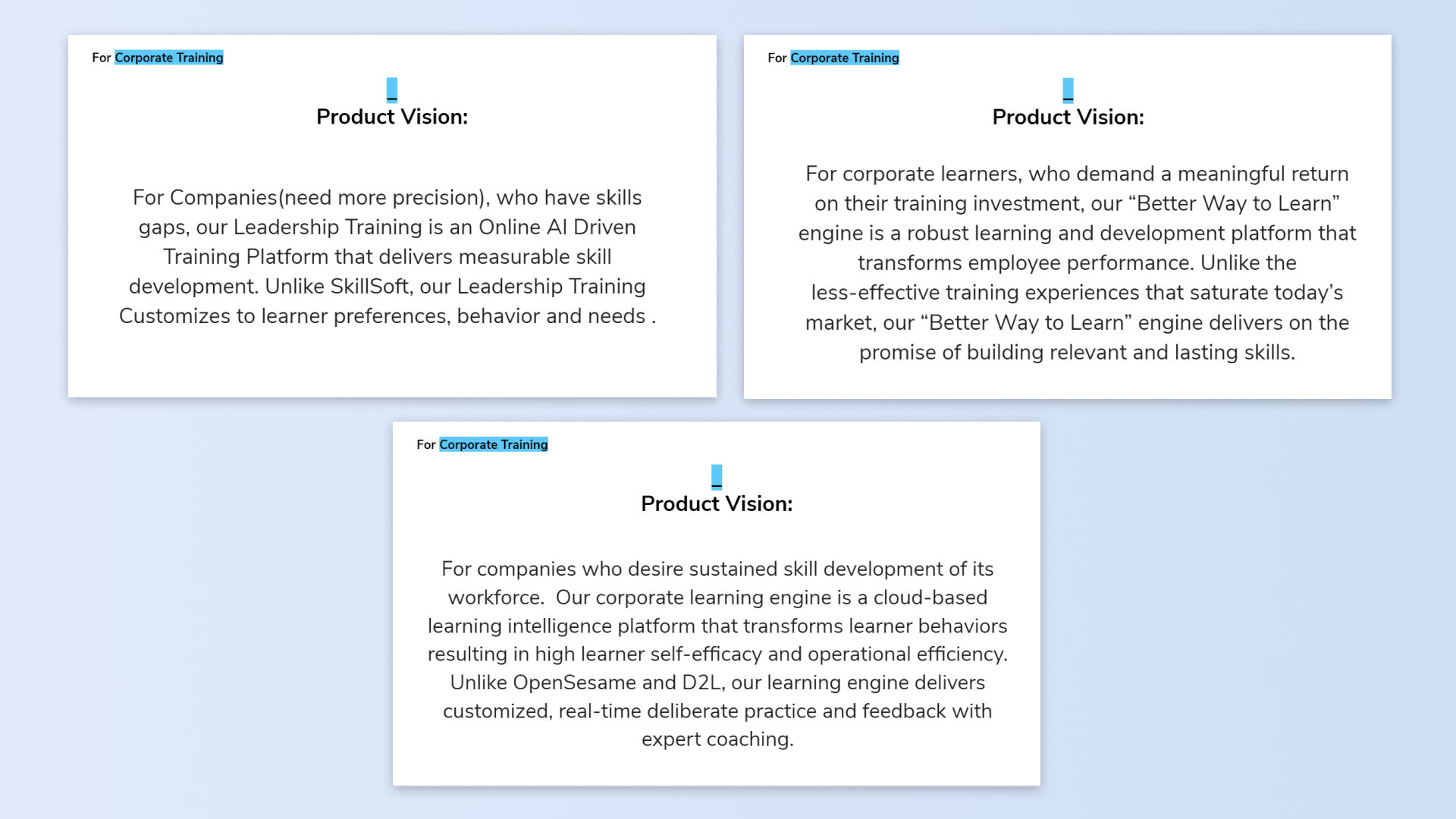
Just a few of the similar-but-different perceptions of the product vision within the team
The problem: an unfocused, hard to sustainably build product
Within the first few weeks of my arrival, I spent time interviewing the team and realized there were differing perceptions of the product and its goals at the time. What they initially had was a 6-week online corporate training product for soft skills that had a differentiator: they used deliberate practice principles by way of a roleplaying capstone to demonstrate the skill growth at the end.
The problem leadership was facing was that the product was too resource-intensive to produce; it wasn’t sustainable to build a business on more like this. With no product manager or experienced product development team member, they also lacked processes to efficiently solve for product problems of this sort. I was the first UX hire they had on the team, and at the time, the only one with any prior experience in a product development environment.
The biggest problems to tackle first:
There was no agreed-upon product vision; everyone on the team thought the product was something slightly different.
The target audience wasn’t well defined; beyond the corporate sector, there was very little industry focus.
Design thinking for alignment and exploration
To tackle the lack of alignment on the product vision, I put together and facilitated a one-day remote design thinking workshop for the team. This was at the height of the COVID pandemic, so a formerly colocated team had been working remotely for several months.
The team of 15 was broken into smaller groups using Zoom breakout rooms and a series of Miro boards. Each team was given a different possibility for the company’s product offerings to work on.
I selected exercises to help us get a clearer picture of our prospective customers, flesh out their needs for the products in question, brainstorm some possible approaches, and tell the story.
The design thinking workshop exercises:
Empathy mapping
Jobs to Be Done
How Might We? Statements
Storyboarding
The exercises were timed, and at the end of the day there would be a feedback session where each team presented their concepts to a panel of experts in corporate training and customer experience.
Panelists responded well to a product concept we called “mastery” at the time. The product was aimed at emerging leaders and would allow them to practice and hone specific soft skills quickly through roleplay exercises and expert feedback. Faster and more focused than most online training, and presumably much more sustainable to produce than the earlier six-week course product.
That in mind, we had a product concept to push forward with.
An unofficial customer experience team was formed
As we pushed forward, I teamed with the general manager and a marketing & strategy consultant to begin to build out customer personas and the customer journey based on what data we had gathered over time from the workshop and prior conversations the general manager had with prospective clients.
We met weekly, working jointly on personas and the customer journey map to help propel the product team forward. The general manager remained our touchpoint for gathering feedback from prospects as he was working on the sales pitch, while the consultant provided us with valuable research and frameworks on which to build our strategy.
I worked with the product team to guide them toward the bigger product picture by socializing the work of our unofficial customer experience team and building out user flows to help surface product gaps quickly and guide the instructional designers on what to work on.
Working as a UX team of one
Some of the biggest struggles in forward momentum were largely due to time and resource constraints. Because the team was inexperienced at product development, the “CX team” and I had to do a lot of guidance and reminding to keep them on track during the process.
As the only UX role in the company, I was not only helping to lead strategic efforts on the product side, but I was creating all UX and marketing artifacts along the way. By the end of this roughly nine-month process, the assets I’d built included, but were by no means limited to:
I planned, designed, and wrote copy for a complete overhaul of the company website
Personas for the various customer profiles we needed to speak to
User flows and service blueprints for the various paths the personas would take
Customer journey mapping as part of the “CX team”
Guiding the product team through prioritization matrix exercises to help organize our workload
Writing and designing emails as part of the product touchpoints
Conducting user interviews and capturing feedback
Building a research filing system to capture our findings more formally
Visual design on all customer-facing assets
Outcome: a more focused minimum viable product
It took tremendous effort on the part of the “CX team,” but we managed to get a minimum viable product built to our satisfaction and began to run tests with the parent company. As of this writing, the test run is currently about to launch, and the “CX team” has turned our efforts toward forming a lead to revenue strategy in order to generate and measure product sales.